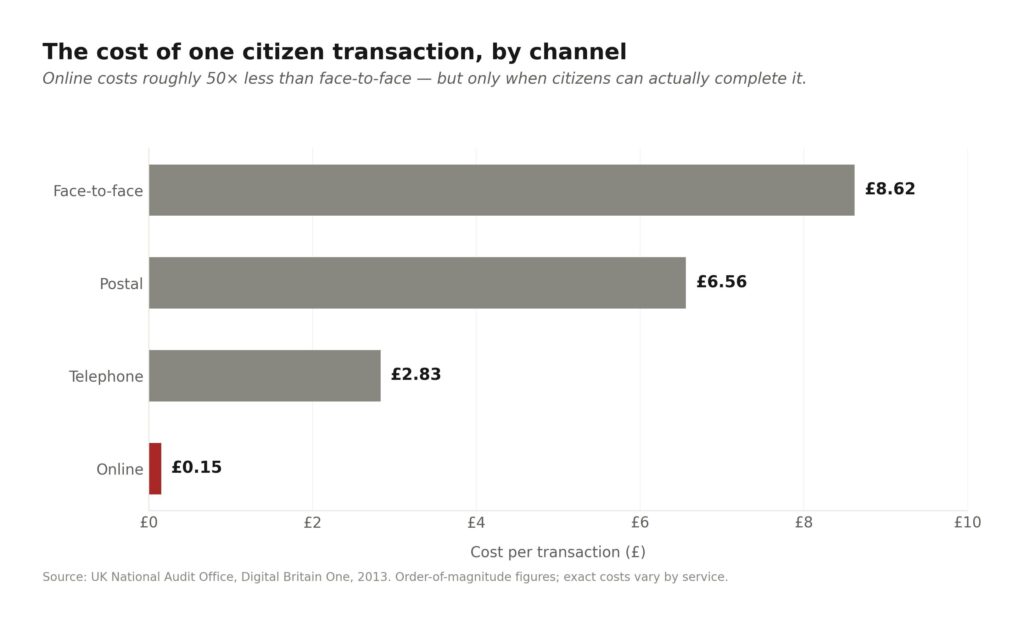
Figures: UK National Audit Office, Digital Britain: One — Shared infrastructure and services for government online, 2013. Illustrative for the order-of-magnitude pattern; exact figures vary by service and have shifted modestly since publication.
Most government leadership conversations about digital channels start with the savings — and the savings are real. A single online transaction costs the agency about 15 pence to deliver. The same transaction handled face-to-face costs nearly £9 — fifty times more.
What the channel-cost figure doesn’t say is that the saving is conditional. The 15p assumes the citizen successfully completes the transaction online. If they get partway through, get stuck, and call the helpline, the cost is the cost of both channels — the failed digital attempt and the phone call that followed. Worse: the citizen now distrusts the digital channel and will start with the phone next time.
This is what UX research and prototyping are actually for. Not “making it look nice.” Making the cheap channel work for the citizens who depend on it, so the cheap channel actually delivers its cost saving instead of becoming an expensive routing step into the call centre.
The right way to think about UX spend in government is not as a separate budget line but as the activation cost of every other digital investment. A £500,000 digital service that 40% of citizens cannot complete is not a £500,000 investment — it’s a £500,000 investment that creates ongoing call-centre demand. The same service with research-led design might cost £550,000 and have 80% completion — and the £50,000 of research pays for itself in deflected calls within months.
Every call to a government call centre costs the agency about £3 in the UK, or its equivalent elsewhere. Multiply that by tens of millions of contacts a year and the call centre is one of the largest line items in any agency’s operating budget.
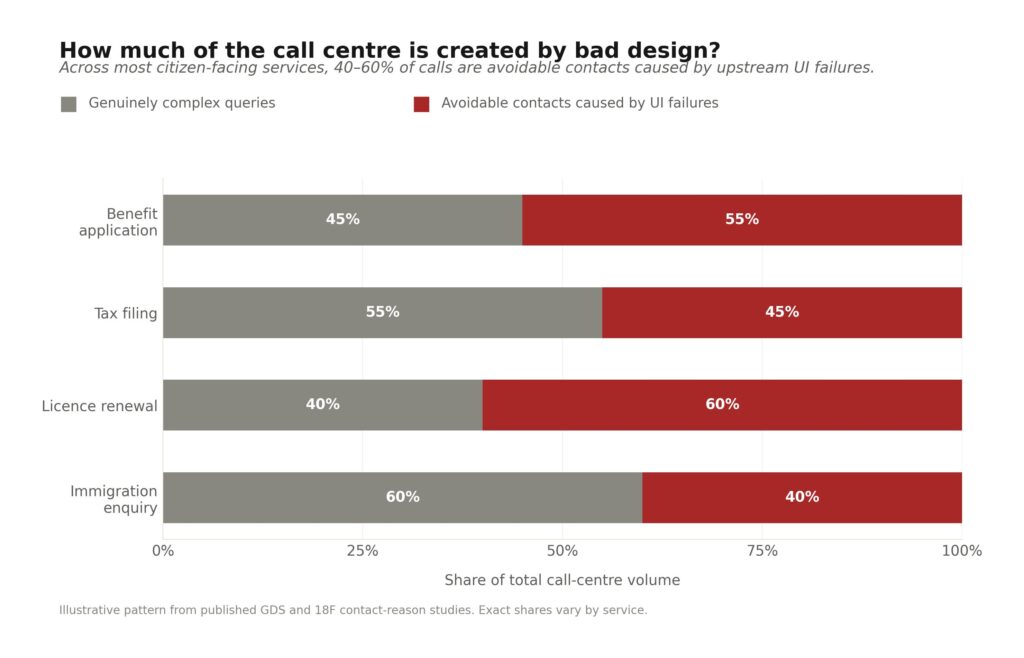
What is rarely measured is how many of those calls were necessary. A genuinely complex query — a citizen with an unusual situation, a question the website couldn’t reasonably answer — is the work the call centre exists to do. An avoidable contact is something else entirely: a citizen who started online, got stuck, gave up, and called for help. Or a citizen who would have used the website but couldn’t find what they needed and called instead. Or a citizen who completed the form but never got the confirmation email and called to check.
When agencies do the work of coding contact reasons against upstream causes, the result is consistent across jurisdictions: 40 to 60 percent of contacts are avoidable, caused by upstream UI or content failures the citizen never should have hit. Those calls are not the call centre’s problem to solve. They are a design problem that the call centre is paying for.
UX research is the cheapest way to find avoidable contacts before they happen. A research-led redesign of a single high-volume page can reduce call volume measurably within weeks. The investment pays back in a quarter, often less.
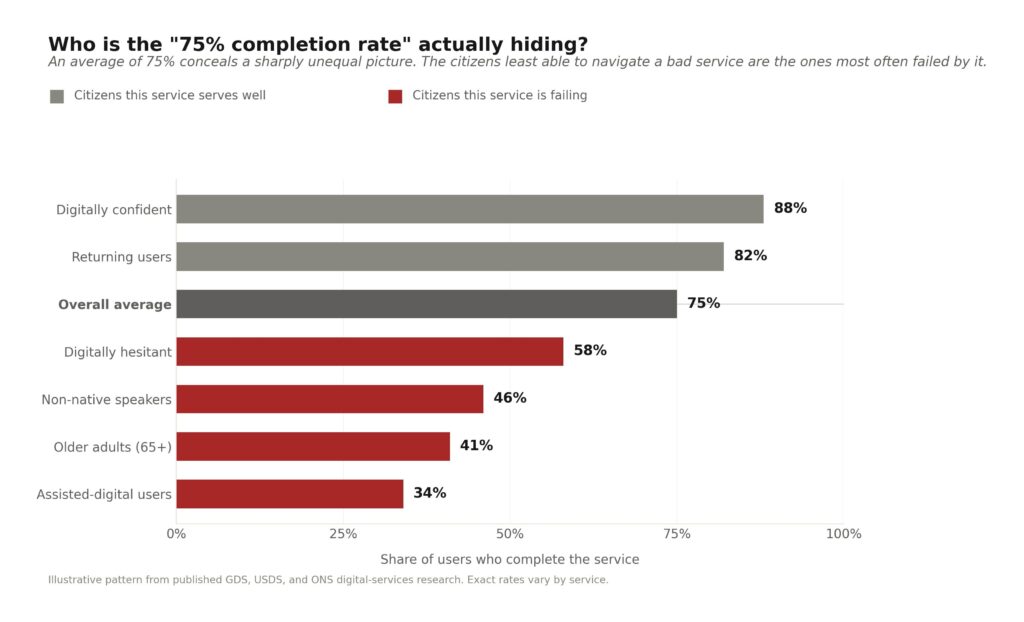
Most service teams report their completion rate as a single number. “Seventy-five percent of citizens complete this service.” It sounds reasonable. It is wrong in two ways.
The first way it is wrong: 25 percent of citizens not completing a service is not reasonable. In any commercial context, that would be a crisis. In government, it is reported as a steady state.
The second way it is wrong: the 75 percent and the 25 percent are not random. The citizens who do not complete are concentrated in specific segments — older adults, non-native speakers, the digitally hesitant, people being helped through the service by someone else. The 75 percent average is the result of confident users completing at near-90 percent rates and harder-to-reach groups completing at 30 to 40 percent. Reporting only the average treats the failure as if it were spread evenly across the population. It is not.
This matters legally, politically, and morally. Legally, because in most jurisdictions a government service that systematically excludes protected groups is a problem. Politically, because the citizens least able to navigate a bad service are often the ones who complain most loudly to their representatives. Morally, because public services exist to serve the public — all of the public, not just the segment easiest to serve.
UX research with hard-to-reach groups is the only way to know who is being failed, and the only way to make the service work for them. It is not an optional component of inclusive government. It is the only mechanism that turns “we want to be inclusive” into a service that actually is.